

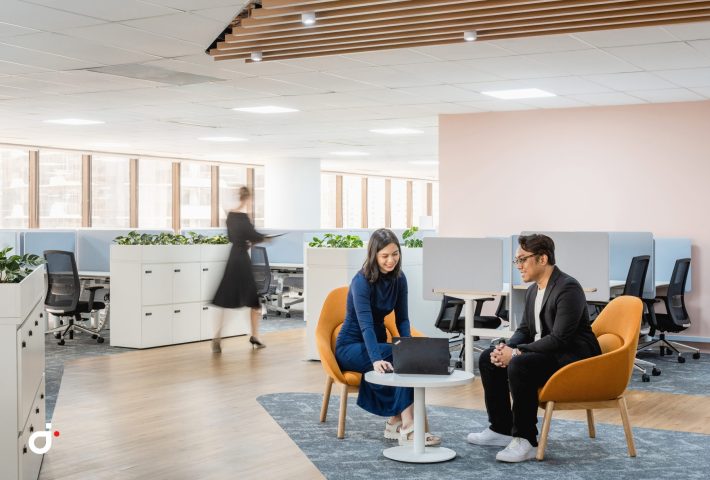
Most office spaces are designed for today’s operations, not tomorrow’s growth.
What feels organised now can quickly become inefficient as teams expand, hybrid work increases, and departments compete for the same space.
Meeting rooms become fully booked. Empty desks go unused. Employees struggle to find quiet spaces for focused work. Teams start overflowing into areas never designed for expansion.
The issue is not always limited office space. More often, it is poor space utilization and rigid office design that cannot adapt to business growth.
At ID Integrated Singapore, we design flexible workspaces built for long term scalability, helping businesses adapt to changing team structures, hybrid work models, and future expansion without constant disruption or costly renovations.
What Is Flexible Office Design?
Flexible office design creates workspaces that can adapt as business operations change, without constant renovations or rebuilding. Instead of fixed layouts, businesses use adaptable spaces that support different work styles, team sizes, and operational needs.
Modern workplaces are no longer built around permanent desks and static office setups. Hybrid work, remote teams, collaboration, and focused work all require different environments within the same office space.
This is why flexible offices often include modular furniture, movable partitions, shared desks, quiet rooms, flexible meeting spaces, and smart workplace technology. The goal is not just modern aesthetics. The goal is operational efficiency, scalability, and long term business support.
Why Traditional Office Design No Longer Works
Traditional office design was built for fixed routines, assigned seating, and employees working from the same location every day. Most layouts were designed around permanence, not flexibility or growth.
Modern workplaces no longer operate that way. Hybrid work, remote schedules, virtual meetings, and collaborative work styles have completely changed how office spaces are used.
As businesses evolve, traditional layouts create inefficiencies. Empty desks, overcrowded meeting rooms, lack of quiet spaces, and rigid departments make the office less functional over time.
The biggest problem is cost and adaptability. Fixed office layouts are expensive to modify, often requiring repeated renovations and operational disruption just to keep up with changing business needs.
At ID Integrated Singapore, we help businesses create flexible office environments that adapt to growth, improve space efficiency, and support modern workstyles without constant reconstruction.
The Core Principles Behind Scalable Office Design
Businesses that prioritize flexibility approach workplace strategy differently. Instead of designing only for current operations, they create office environments that can support future growth, evolving work styles, and long term operational efficiency through specialised office interior design services in Singapore.
Design Around Different Work Styles
Not every employee works the same way, which means office design should not force everyone into a single environment. Some employees require quiet rooms and focused work areas to complete tasks that demand concentration. Others require collaborative spaces, flexible meeting rooms, or open layouts that support communication and teamwork.
A scalable office balances these requirements by creating multiple environments within the same workplace. This may include individual workstations, shared desks, private spaces, meeting rooms, training rooms, event spaces, and quiet zones that support different forms of work throughout the day.
When workplace design reflects how employees actually operate, businesses often experience stronger employee satisfaction, improved productivity, and a healthier company culture.
Prioritize Flexible Space Planning
A flexible workplace should be designed for adaptability rather than permanence. Instead of relying heavily on fixed rooms, scalable office design uses modular furniture, movable partitions, and flexible space planning that allows businesses to adjust layouts without major construction.
This flexibility becomes extremely important during periods of business growth. Teams can expand into new spaces without disrupting operations. Departments can reorganize more efficiently. Businesses can create temporary project zones, increase seating capacity, or adjust layouts based on hybrid schedules without requiring expensive renovation work.
The ability to adapt quickly improves operational agility while reducing long term disruption costs.
Integrate Smart Workplace Technology
Technology infrastructure now plays a major role in modern workplace design. Flexible office environments depend on systems that support collaboration, mobility, communication, and operational efficiency across different work settings.
Smart workplace technology may include interactive screens, wireless collaboration systems, cloud connectivity, occupancy tracking, integrated communication platforms, and smart booking systems for on demand meeting rooms. These systems allow employees to move seamlessly between spaces while maintaining productivity throughout the day.
Without proper technology infrastructure, even visually attractive office environments eventually become operationally frustrating. Businesses that overlook this area often struggle with inefficient meeting coordination, poor collaboration experiences, and inconsistent workplace functionality.
Improve Space Utilization
One of the most common workplace strategy mistakes is designing for maximum occupancy instead of actual operational behaviour. Modern office design focuses more heavily on understanding how employees truly use the space throughout the week.
This includes identifying which areas remain underused, how often meeting rooms are occupied, whether private spaces are sufficient, and how hybrid schedules affect attendance patterns. The goal is not simply fitting more employees into the office. The goal is maximizing the effectiveness of every square foot while maintaining employee comfort and operational flow.
Businesses that improve space utilization often reduce unnecessary expansion costs while creating a more functional office environment.
Key Features of Flexible Office Design
Modular Furniture
Modular furniture allows businesses to adjust layouts without constantly replacing infrastructure. Teams can reorganize seating arrangements, collaboration areas, and workstations based on changing operational requirements or project needs. This flexibility supports long term scalability while maintaining consistency across the office environment.
Movable Walls and Flexible Partitions
Movable walls and movable partitions create adaptable office spaces without requiring permanent renovation work. Businesses can transform large rooms into smaller collaboration areas, expand private spaces for growing departments, or convert training rooms into event spaces depending on operational demands.
This approach significantly improves flexibility while reducing future renovation costs.
Quiet Zones and Focus Areas
While open layouts improve collaboration, they can also create distractions that reduce focused work performance. Employees still require quiet rooms, phone booths, and private spaces where they can handle private calls, complete deep focus tasks, or work without interruption.
A balanced office environment supports both collaboration and concentration instead of prioritizing one at the expense of the other.
Flexible Meeting Rooms
Modern meeting rooms must support both physical and hybrid collaboration. Businesses increasingly require flexible meeting spaces equipped with smart scheduling systems, integrated presentation tools, hybrid conferencing capabilities, and adaptable seating arrangements that can support different meeting formats throughout the day.
Ergonomic Furniture and Employee Comfort
Employee experience is heavily influenced by physical comfort within the workplace environment. Ergonomic furniture improves posture, reduces fatigue, and creates healthier working conditions that support productivity over longer periods.
Businesses investing in employee wellbeing often see improvements in employee satisfaction, retention, and overall engagement.
How Flexible Office Design Supports Business Growth
Business growth creates operational pressure, and office environments should reduce that pressure rather than increase it. A scalable office allows businesses to adapt more efficiently without constant disruption, relocation, or repeated redesign work.
When new team members join, flexible office environments make it easier to expand seating arrangements, reorganize departments, and create new collaboration spaces without rebuilding the entire office. This creates smoother operational continuity during expansion phases.
Flexible office design also improves cost efficiency over time. Businesses avoid frequent costly renovations because the office is already designed for adaptability. Predictable monthly costs become easier to manage when companies are not repeatedly investing in reconstruction work every few years.
At the same time, modern employees increasingly expect flexibility within the workplace. They want office environments that support focused work, collaboration, privacy, comfort, and hybrid work arrangements. Businesses that fail to adapt to these expectations may eventually experience declining employee satisfaction and weaker retention.
Operational agility becomes another major advantage. Departments can scale more efficiently, project teams can reorganize quickly, and businesses can respond to changing operational priorities without creating unnecessary disruption across the workplace.
Flexible Office Design for Small Businesses and Large Organizations
Scalable workplace design benefits both small businesses and large organizations, although the operational priorities may differ.
For small businesses, budget constraints make flexibility especially important. Smaller companies often cannot afford repeated renovation cycles or expensive relocations every time operations expand. Flexible office design allows them to maximize existing space while maintaining long term adaptability as the business grows.
Large organizations face different operational challenges. Multiple departments, hybrid schedules, regional collaboration, remote work integration, and project based work structures require office environments that can support constant operational movement without reducing efficiency.
Despite these differences, both small businesses and large organizations share the same underlying need. They require office environments that can evolve alongside operational growth instead of becoming obstacles to expansion.
Common Mistakes Businesses Make
One of the biggest mistakes businesses make is designing office space purely around current operational needs without considering future growth. While the office may feel sufficient initially, limitations often appear quickly once teams expand or operational structures evolve.
Another common issue is overcommitting to fixed layouts. Permanent rooms reduce flexibility and make future adjustments significantly more expensive. Businesses eventually become trapped in environments that no longer support how employees actually work.
Some companies also focus too heavily on aesthetics while overlooking operational functionality. Visual branding is important, but office environments must still support collaboration, focused work, operational flow, and employee comfort on a daily basis.
Technology infrastructure is another area businesses frequently underestimate. Without integrated systems that support modern work environments, hybrid collaboration and flexible workplace operations become difficult to manage effectively.
The Future of Workplace Design
The future of workplace design is centered around adaptability, operational agility, and employee experience. Businesses are gradually moving away from rigid office models and adopting flexible workplaces that can support changing operational demands over time.
Modern office environments are no longer simply physical locations where employees sit and work. Offices now function as strategic operational tools that influence collaboration, productivity, company culture, employee satisfaction, and long term business scalability, making thoughtful corporate interior design in Singapore a key part of long term planning.
Businesses that continue relying on outdated workplace models may eventually face ongoing renovation costs, inefficient space utilization, and office environments that fail to support modern operational demands. Businesses that prioritize flexibility position themselves more effectively for sustainable growth.
Build a Flexible Office That Grows With Your Business
A scalable office environment is not about following workplace trends. It is about creating a professional workspace that continues supporting operational efficiency, employee experience, and business growth as the organisation evolves.
The most effective office environments are designed with adaptability from the beginning. They support focused work, collaboration, private spaces, hybrid schedules, operational agility, and changing team structures without constant disruption or expensive reconstruction work.
At IDI Singapore, flexible office design is approached strategically to help businesses create scalable workspaces that align with long term operational goals, workplace functionality, and future growth opportunities.

